March 6, 7 & 8 – Three great days at sea to watch movies, chat with fellow cruisers, go to the evening performances and just generally have a good time. Tomorrow we are in Brunei. Actually to be fully correct the State of Brunei, ‘Abode of Peace’, Malay Negara Brunei Darussalam. Longest country name I’ve ever seen. It’s an Islamic sultanate on the Island of Borneo. It shares the island with The Malaysian state of Sarawak, which surrounds Brunei on all sides. The largest part of Borneo, over half, is occupied Indonesia. The current sultan’s name is His Majesty Sultan Haji Hassanal Bolkiah Mu’zzaddin Waddaulah the Sultan and Yang Di-Pertuan of Brunei Darussalam. We just call him Haji. We have been warned that the country is very Islamic and that we’ll all have to wear long pants or dresses and shirts with sleeves. That’s not good news as we are only 4 degrees north of the Equator and the weather will be hot with 90% humidity. Double Yikes!!
 March 9 – Here we are in Brunei. The entry for yesterday will be the last time I’ll use the full name for either the country or the sultan. This morning I got up early to get breakfast and prepare to video the musicians and dancers that were to welcome us into the port. We were supposed to pick up the pilot at 7:30AM, be docked by 8:30 and cleared to disembark the ship at 10AM. As we approached the entrance to the harbor the ship slowed to a stop and then just sat there for an hour. The pilot had not come out. At 8:45 the pilot came and we got underway. Apparently he brought the immigration officials also as there’s a lot of paperwork to land here but we were still cleared to disembark the ship by 10AM as scheduled.
We skipped seeing the major city here and went straight to the rainforest. Brunei shares the Island of Borneo with parts of two other countries, Malaysia and Indonesia. In fact Brunei only occupies about 1-2% of the land on Borneo. However, the land it occupies has about 95% of the island’s oil reserves. This is a wealthy place. Everyone has a car, there are no taxes, and education, healthcare and most other public services are free. The government builds you a nice home when you get married and after paying a small amount based on your income for 10 years, the land and house are yours.
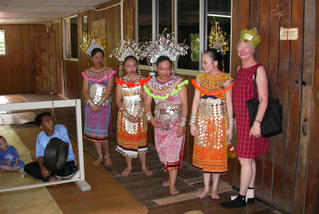
The country is divided into 4 sections and we will be in 3 of them to get to the area of the rainforest where the Dayak tribe we will be visiting resides. The Dayak people are very short. The tallest man I saw was about 5’4”. The women are smaller, about 5’1-2” or less (right). The Dayaks are also known as the “Headhunters of Borneo”. This is what they were called in articles in newspapers and adventure magazines 70 to 80 years ago when journalists began coming here. Headhunting was ended some time in the mid-twentieth century. No one is very specific about when the last head was taken. I’m hoping that’s not because the date keeps moving forward!!
The Dayaks live in “Longhouses” (above left) and have for several hundred years. The longhouse we will be visiting is over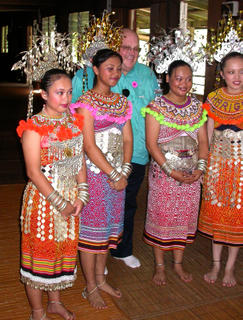 100 years old. It has been moved twice due to various geological events. They take it apart and reassemble it in the new location. The house itself is a large rectangular structure up on stilts. In the front, it has a set of five stairs leading up to a small covered porch. The porch has benches built in along each side for sitting down to take off your shoes. Each set of stairs has a separate little porch. From this porch another set of five stairs leads to a long continuous veranda. In this particular long house there are 12 separate living spaces arranged like town houses, so there are 12 sets of steps and porches but the veranda itself is not divided at all.
Directly across from the upper stairs is an entrance to the house proper so there are 12 doors. However they all lead to a large common room that extends the entire length of the building. Directly across from these doors are the doors to the 12 separate living quarters. The large common room is carpeted with large loose bamboo mats. Here a small band and four young girls dancing (left) greeted us. The girls were sisters ages 15-18 and they were very cute. Their costumes were very colorful and consisted of many pieces.
A long skirt was the simple part. Above the waist they had a sort of sleeveless shirt, a vest and a large collar. On their heads they had a hairpiece that was attached at the back of their hair and was flat facing forward and shaped like a square with one of the corners pointing down. Attached to the two downward sloping sides were silver and gold colored metal pieces that looked like flowering grass plants. They wore a wide decorated belt around their waist. One girl was proud of the fact that her belt had been her grandmother’s. Over this belt they wore chains of various sized metal disks. There could be 3 to 5 rows of the disks in the chain belt. From this metal belt strings of metal disks were attached that dangled loosely so they could strike each other and ring as the girls danced. To add to the body music they also wore metallic arm and ankle bracelets that rang together as they moved.
 The band consisted of one man playing what looked like bronze British navy hats, short cylinders with sloping sides, a flat top and a large ball in the middle of the top (right). To play them he struck them on top of the ball. They were setting on a divided large wooden tray on the floor. They were different diameters to create the various notes. Just behind him was man playing a long narrow bamboo drum. On his left was a woman playing a gong and on her left was a man playing an instrument that looked like a circular bronze seat cushion that was hanging from the same frame as the gong. The music was quite pleasant. There were 8 bronze hats in the tray so I’m assuming that they work on the same octave as we do or at least a similar 8-note scale.
Then the chief came out and played a wooden, guitar like instrument shaped like a very long necked, flat fronted wine bottle (left). He wore a headdress with long, probably 3 foot plus, feathers around the crown, sort of like an American Indian headdress. After that, the second in command gave us a blowpipe demonstration. He hung a dartboard across the common room and shot 3 darts into it before offering us a chance. I was ready. Diana brought a short blowpipe back from Peru and I’d been shooting it across the living room into the back of one of our chairs. His pipe was about five and a half feet long and the darts were about 6 inches. I shot one into the triple area directly in the center of the board. I didn’t use quite enough air and it dropped about 4 inches crossing the room. Only one other man would try it and he did well also.
The Dayak weave in split bamboo and they had some of their wares for sale. Diana bought a cylindrical container and a men’s hat I’m going to wear on Sultan of Brunei night on the ship. They also have cockfights and on the way to the bus we passed two men with fighting roosters. One of them was huge.
As we were leaving the chief offered us a taste of his wine (left). He said it was papaya wine. It tasted like sake so I suspect that rice is involved somehow. It was fairly strong but not unpleasant. Being a Muslim country, Brunei is officially ‘dry’. However an exemption is made for the native tribes to allow them to make alcohol for their own use. Visitors coming into the country can bring in 12 beers and 2 liters of alcohol for their own use. It has to be consumed in private. No public drinking is allowed.
 After that it was on the bus and back into town. On the way we stopped at a small display of the various animals, birds and plants of the Bruneian rainforest. Our guide had a cicada and was it every a big one. He let us hold it (right). If you put a little gentle pressure on their back they make their noise.
After that it was on to tea at the Empire Hotel. Our guide claims that there are only two 7-star hotels in the world, the Empire Hotel here and one in Dubai. I have to admit, the hotel was impressive. A huge atrium, all glass on one side and about 10 floors tall. All the floors are open on the atrium end and are terraced with each floor being shorter than the one below it (below, right). The staff was very friendly and their English was perfect. They had a human chain of guides about 10 feet apart to direct us to the tea spot. It was one floor down from the lobby and on a little peninsula over looking the atrium. Through the glass side we could see the gardens, pool area and the ocean. Very beautiful. After that it was back to the ship. We arrived late and the ship had to be held for us. It was a long, hot but fun day. Dress for the evening was formal and the theme was the Sultan of Brunei. I wore my white dinner jacket with my Newfoundland tartan tie and the bamboo hat Diana bought from the Dayaks (Below left). It was a big hit with the staff and passengers as well. Nothing like something unusual to spice up formal nights.

 March 10 & 11 – Two more ‘at sea’ days to charge up for the port of Hong Kong. My Tai Chi is proceeding nicely. I love some of the breathing exercises like the lotus or green dragon. They are short enough to learn easily but long enough to be fun. The regular tai chi sets are fairly long and require days and days to learn. We started a new set in Sydney and have had 13 sea days since them and I think we’re only about half way through learning the entire exercise. I really enjoy it and hope I can keep it up when I get home.
March 12 – First day in Hong Kong. It’s very cloudy and raining off and on. Diana is headed to the Li River on an overnight trip. I’m staying in Hong Kong to explore. She’s going to write a report of her own on that trip. Right now I’m going to stick to my time in HK.
I took a morning tour of Victoria Island. Perhaps a little review of the geography would be helpful. The area generally referred to as British Hong Kong is made up of three main sections, Hong Kong Island, Kowloon and the New Territories. The ship is docked in Kowloon, not in HK proper. Kowloon is directly across Victoria Harbor from HK. Kowloon is on the mainland and is connected to mainland china by the New Territories. The, ‘so-called’ New Territories were given to the British in the 1800s after they defeated China in the Opium Wars.
Editorial Note: Here in China they have a different sense of time than we do. For example, my tour guide this AM said that his father recently came to settle in HK from the New Territories. I found out later that this had happened over 60 years ago. This is ‘recent’ in the Chinese mind. Another time a guide refereed to a building as ‘new’. The truth is the building was over 400 years old. The Chinese have a much longer view of history than we do. They also have a much more patient view toward the future. If they are fairly certain something will happen they are willing to wait patiently for several hundred years for it to happen. They are content to wait as long as they see the future potential in the circumstances. This is probably one reason why Taiwan has been tolerated for such a long time. Thus after 200 years the New Territories are still ‘new’ in the Chinese view on things.
 Technically, the British did not have to return Hong Kong Island in 1997. The lease that expired that year was only on Kowloon and the New Territories. The island and HK city were not leased but were owned outright by the British. However, if they had not given that back as well the Chinese could have cut off their electricity and water supplies. This, as well as diplomatic factors, caused the British to return all the land to China at the same time. Three years later the Portuguese gave back Macao with little fanfare or notice.

The tour headed around the island and made a stop at Aberdeen. This is the fishing port that is famous for the live aboard sampans and other boats. There are thousands of them. I understand that there are fewer every year as more of the people get regular land jobs and abandon the sampan way of life. We took a tour of the harbor on a sampan (above left) piloted by a woman of indeterminate age. She could have been 40 or 70, I couldn’t tell. She was a very skillful helmsman and gave us a great ride. One of the landmarks of Aberdeen harbor is Jumbo Restaurant (right). It’s the world’s largest floating restaurant. It’s six stories high, granted only 3 of them run the full length of the restaurant, and I estimate it’s about 250’ long by 25-30 feet wide. It has it’s own fleet of boats to transfer people from various spots on land out to eat. As you might guess it’s mainly a seafood place. We also saw part of the HK fishing fleet, houseboats and other assorted vessels. A great ride!
 We reboarded the bus and continued to the southern side of the island to the Deep Water and Repulse Bays. Deep Water Bay is the site of the harbor for very large ships. Repulse Bay has very nice, broad sand beaches and a Taoist area at the east end. The Taoist area has images of several of their gods (left), some large some small. Most are very attractive. Lot’s of the locals, most of them female, were lining up to touch and rub one of the plainer, smaller, ugly ones. I inquired and was told it was the “money god” (below right). I guess in Taoist theology, as in life, if you’ve got the bucks you can attract all sorts of women. When the person finally arrived at the statue they would place their hands on the top of its head and rub all the way down the face, neck, shoulders and chest. The truly devout (or money hungry?) would rub all the way down to its feet. It was fun just watching the action he was getting. There were many other gods represented, all of them more attractive and colorful than ‘money man’.
 March 9 – Here we are in Brunei. The entry for yesterday will be the last time I’ll use the full name for either the country or the sultan. This morning I got up early to get breakfast and prepare to video the musicians and dancers that were to welcome us into the port. We were supposed to pick up the pilot at 7:30AM, be docked by 8:30 and cleared to disembark the ship at 10AM. As we approached the entrance to the harbor the ship slowed to a stop and then just sat there for an hour. The pilot had not come out. At 8:45 the pilot came and we got underway. Apparently he brought the immigration officials also as there’s a lot of paperwork to land here but we were still cleared to disembark the ship by 10AM as scheduled.
We skipped seeing the major city here and went straight to the rainforest. Brunei shares the Island of Borneo with parts of two other countries, Malaysia and Indonesia. In fact Brunei only occupies about 1-2% of the land on Borneo. However, the land it occupies has about 95% of the island’s oil reserves. This is a wealthy place. Everyone has a car, there are no taxes, and education, healthcare and most other public services are free. The government builds you a nice home when you get married and after paying a small amount based on your income for 10 years, the land and house are yours.

The country is divided into 4 sections and we will be in 3 of them to get to the area of the rainforest where the Dayak tribe we will be visiting resides. The Dayak people are very short. The tallest man I saw was about 5’4”. The women are smaller, about 5’1-2” or less (right). The Dayaks are also known as the “Headhunters of Borneo”. This is what they were called in articles in newspapers and adventure magazines 70 to 80 years ago when journalists began coming here. Headhunting was ended some time in the mid-twentieth century. No one is very specific about when the last head was taken. I’m hoping that’s not because the date keeps moving forward!!
The Dayaks live in “Longhouses” (above left) and have for several hundred years. The longhouse we will be visiting is over
 100 years old. It has been moved twice due to various geological events. They take it apart and reassemble it in the new location. The house itself is a large rectangular structure up on stilts. In the front, it has a set of five stairs leading up to a small covered porch. The porch has benches built in along each side for sitting down to take off your shoes. Each set of stairs has a separate little porch. From this porch another set of five stairs leads to a long continuous veranda. In this particular long house there are 12 separate living spaces arranged like town houses, so there are 12 sets of steps and porches but the veranda itself is not divided at all.
Directly across from the upper stairs is an entrance to the house proper so there are 12 doors. However they all lead to a large common room that extends the entire length of the building. Directly across from these doors are the doors to the 12 separate living quarters. The large common room is carpeted with large loose bamboo mats. Here a small band and four young girls dancing (left) greeted us. The girls were sisters ages 15-18 and they were very cute. Their costumes were very colorful and consisted of many pieces.
A long skirt was the simple part. Above the waist they had a sort of sleeveless shirt, a vest and a large collar. On their heads they had a hairpiece that was attached at the back of their hair and was flat facing forward and shaped like a square with one of the corners pointing down. Attached to the two downward sloping sides were silver and gold colored metal pieces that looked like
 flowering grass plants. They wore a wide decorated belt around their waist. One girl was proud of the fact that her belt had been her grandmother’s. Over this belt they wore chains of various sized metal disks. There could be 3 to 5 rows of the disks in the chain belt. From this metal belt strings of metal disks were attached that dangled loosely so they could strike each other and ring as the girls danced. To add to the body music they also wore metallic arm and ankle bracelets that rang together as they moved.
 The band consisted of one man playing what looked like bronze British navy hats, short cylinders with sloping sides, a flat top and a large ball in the middle of the top (right). To play them he struck them on top of the ball. They were setting on a divided large wooden tray on the floor. They were different diameters to create the various notes. Just behind him was man playing a long narrow bamboo drum. On his left was a woman playing a gong and on her left was a man playing an instrument that looked like a circular bronze seat cushion that was hanging from the same frame as the gong. The music was quite pleasant. There were 8 bronze hats in the tray so I’m assuming that they work on the same octave as we do or at least a similar 8-note scale.
Then the chief came out and played a wooden, guitar like instrument shaped like a very long necked, flat fronted wine bottle (left). He wore a headdress with long, probably 3 foot plus, feathers around the crown, sort of like an American Indian headdress. After that, the second in command gave us a blowpipe demonstration. He hung a dartboard across the common room and shot 3 darts into it before offering us a chance. I was ready. Diana brought a short blowpipe back from Peru and I’d been shooting it across the living room into the back of one of our chairs. His pipe was about five and a half feet long and the darts were about 6 inches. I shot one into the triple area directly in the center of the board. I didn’t use quite enough air and it dropped about 4 inches
 crossing the room. Only one other man would try it and he did well also.
The Dayak weave in split bamboo and they had some of their wares for sale. Diana bought a cylindrical container and a men’s hat I’m going to wear on Sultan of Brunei night on the ship. They also have cockfights and on the way to the bus we passed two men with fighting roosters. One of them was huge.
As we were leaving the chief offered us a taste of his wine (left). He said it was papaya wine. It tasted like sake so I suspect that rice is involved somehow. It was fairly strong but not unpleasant. Being a Muslim country, Brunei is officially ‘dry’. However an exemption is made for the native tribes to allow them to make alcohol for their own use. Visitors coming into the country can bring in 12 beers and 2 liters of alcohol for their own use. It has to be consumed in private. No public drinking is allowed.
 After that it was on the bus and back into town. On the way we stopped at a small display of the various animals, birds and plants of the Bruneian rainforest. Our guide had a cicada and was it every a big one. He let us hold it (right). If you put a little gentle pressure on their back they make their noise.
After that it was on to tea at the Empire Hotel. Our guide claims that there are only two 7-star hotels in the world, the Empire Hotel here and one in Dubai. I have to admit, the hotel was impressive. A huge atrium, all glass on one side and about 10 floors tall. All the floors are open on the atrium end and are terraced with each floor being shorter than the one below it (below, right). The staff was very friendly and their English was perfect. They had a human chain of guides about 10 feet apart to direct us to the tea spot. It was
 one floor down from the lobby and on a little peninsula over looking the atrium. Through the glass side we could see the gardens, pool area and the ocean. Very beautiful. After that it was back to the ship. We arrived late and the ship had to be held for us. It was a long, hot but fun day. Dress for the evening was formal and the theme was the Sultan of Brunei. I wore my white dinner jacket with my Newfoundland tartan tie and the bamboo hat Diana bought from the Dayaks (Below left). It was a big hit with the staff and passengers as well. Nothing like something unusual to spice up formal nights.
 March 10 & 11 – Two more ‘at sea’ days to charge up for the port of Hong Kong. My Tai Chi is proceeding nicely. I love some of the breathing exercises like the lotus or green dragon. They are short enough to learn easily but long enough to be fun. The regular tai chi sets are fairly long and require days and days to learn. We started a new set in Sydney and have had 13 sea days since them and I think we’re only about half way through learning the entire exercise. I really enjoy it and hope I can keep it up when I get home.
March 12 – First day in Hong Kong. It’s very cloudy and raining off and on. Diana is headed to the Li River on an overnight trip. I’m staying in Hong Kong to explore. She’s going to write a report of her own on that trip. Right now I’m going to stick to my time in HK.
I took a morning tour of Victoria Island. Perhaps a little review of the geography would be helpful. The area generally referred to as British Hong Kong is made up of three main sections, Hong Kong Island, Kowloon and the New Territories. The ship is docked in Kowloon, not in HK proper. Kowloon is directly across Victoria Harbor from HK. Kowloon is on the mainland and is connected to mainland china by the New Territories. The, ‘so-called’ New Territories were given to the British in the 1800s after they defeated China in the Opium Wars.
Editorial Note: Here in China they have a different sense of time than we do. For example, my tour guide this AM said that his father recently came to settle in HK from the New Territories. I found out later that this had happened over 60 years ago. This is ‘recent’ in the Chinese mind. Another time a guide refereed to a building as ‘new’. The truth is the building was over 400 years old. The Chinese have a much longer view of history than we do. They also have a much more patient view toward the future. If they are fairly certain something will happen they are willing to wait patiently for several hundred years for it to happen. They are content to wait as long as they see the future potential in the circumstances. This is probably one reason why Taiwan has been tolerated for such a long time. Thus after 200 years the New Territories are still ‘new’ in the Chinese view on things.
 Technically, the British did not have to return Hong Kong Island in 1997. The lease that expired that year was only on Kowloon and the New Territories. The island and HK city were not leased but were owned outright by the British. However, if they had not given that back as well the Chinese could have cut off their electricity and water supplies. This, as well as diplomatic factors, caused the British to return all the land to China at the same time. Three years later the Portuguese gave back Macao with little fanfare or notice.
The tour headed around the island and made a stop at Aberdeen. This is the fishing port that is famous for the live aboard sampans and other boats. There are thousands of them. I understand that there are fewer every year as more of the people get regular land jobs and abandon the sampan way of life. We took a tour of the harbor on a sampan (above left) piloted by a woman of indeterminate age. She could have been 40 or 70, I couldn’t tell. She was a very skillful helmsman and gave us a great ride. One of the landmarks of Aberdeen harbor is Jumbo Restaurant (right). It’s the world’s largest floating restaurant. It’s six stories high, granted only 3 of them run the full length of the restaurant, and I estimate it’s about 250’ long by 25-30 feet wide. It has it’s own fleet of boats to transfer people from various spots on land out to eat. As you might guess it’s mainly a seafood place. We also saw part of the HK fishing fleet, houseboats and other assorted vessels. A great ride!
 We reboarded the bus and continued to the southern side of the island to the Deep Water and Repulse Bays. Deep Water Bay is the site of the harbor for very large ships. Repulse Bay has very nice, broad sand beaches and a Taoist area at the east end. The Taoist area has images of several of their gods (left), some large some small. Most are very attractive. Lot’s of the locals, most of them female, were lining up to touch and rub one of the plainer, smaller, ugly ones. I inquired and was told it was the “money god” (below right). I guess in Taoist theology, as in life, if you’ve got the bucks you can attract all sorts of women. When the person finally arrived at the statue they would place their hands on the top of its head and rub all the way down the face, neck, shoulders and chest. The truly devout (or money hungry?) would rub all the way down to its feet. It was fun just watching the action he was getting. There were many other gods represented, all of them more attractive and colorful than ‘money man’.
After that it was up to Victoria Peak for a view over HK. Well, Victoria Peak was above the cloud level so absolutely no view was available. Our tour included entry to Madam Trousseau’s Wax Museum. I posed for a picture with Humphrey Bogart and Chiyonofuji. Bogart was dressed in his white jacket outfit from Casablanca. Chiyonofuji (below left) was in his sumo belt and standing in a pose from the sumo ring entry ritual. He’s one of the best Yokozuna that sumo has ever seen. In fact, since his retirement, he has formed his own dojo and has trained several very successful sumotori, including one who also made the rank of Grand Champion or Yokozuna. This is a pretty good record as there have only been 30 or 40 men promoted to that rank in the history of sumo, several hundred years. He is one of the lightest men ever to reach the top of the sport. They had several nice displays. One had Winston Churchill and Adolph Hitler standing side by side.

After that is was back to the ship. I spent the afternoon walking around Kowloon going into camera shops looking for a replacement for my broken digital. I went in several stores from large chain stores to small kiosks. Usually the further you are from the ship the better the prices but in this case the little shop just off the pier from the ship had the lowest price. I want to look around tomorrow to get an idea of prices in HK.
In the evening several of us went to a little fishing village on the Kowloon coast to have a seafood dinner. Just walking to the restaurant was fun. We were in a narrow walkway with fruit and seafood markets on either side of us. There were a few restaurants mixed in. I got the idea that when you order something the restaurant goes out to the fish shops and buys what he needs to make your order. All the fish are alive in the markets. The variety was amazing, from huge grouper to very small shrimp, it was all there. Amazingly, even with all the fish stalls and the small space there was no fishy smell at all. Wonderful.


 The fish being cut up in the picture on the top right is a monkfish. The stick like things in front of the fish are razor clams. There are also some scallops and a giant clam on the table. The top left picture is a display of shellfish and crustaceans. They have a large variety of crabs. The lobsters are the Spiny (clawless) variety like we have on the west coast of the USA. There appear to be several types of these one of which has a bluish shell. The fish tank in the picture on the bottom left is the most colorful display of fish I’ve ever seen in a fish market. There were two fruit stands mixed
 in with the fish markets. The large fruit to the right of the pineapples in the bottom right picture are durian. This fruit smells so bad when cut open that it is forbidden to eat it in public places and you can’t even carry them on aircraft or trains. It’s white inside and has a custard-like taste that is very nice, but the smell is terrible. I guess it’s like my people’s Limburger cheese. Smells rotten, tastes great!
After that we went to the Temple Street night market (right). During the day vehicles use the street, but in the evening it is closed and vendors of all sorts set up stalls to sell everything from jewelry and clothing to electronics and DVDs. I bought a few small things. The picture on the right is a display of beaded handbags. Then it was back to the ship.
(c) Rod Longenberger - 2005


